 Enhydra
lutris (sea otters) are the smallest marine mammals weighing a
maximum of 39kg and measuring a maximum of 1.5 metres in length. Sea otters have an average lifespan of 23 years (Estes, 1980). Sea otters have been considered endangered by the IUCN since 2000 citing population declines as the reasoning (Doroff and Burdin, 2015). Some estimates of population loss are as much as 50 % across three generations, equivalent to 45
years (Jameson et al., 1982; Kenyon, 1969; Tinker et al., 2005).
Enhydra
lutris (sea otters) are the smallest marine mammals weighing a
maximum of 39kg and measuring a maximum of 1.5 metres in length. Sea otters have an average lifespan of 23 years (Estes, 1980). Sea otters have been considered endangered by the IUCN since 2000 citing population declines as the reasoning (Doroff and Burdin, 2015). Some estimates of population loss are as much as 50 % across three generations, equivalent to 45
years (Jameson et al., 1982; Kenyon, 1969; Tinker et al., 2005).
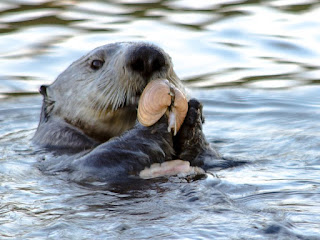

It is also considered that anthropogenic effects such as oil
spills are the most significant threat to Enhydra
lutris (Geraci and Williams, 1990). As highly social organisms, sea otters often form same-sex rafts of up to 2000 individuals.
Although they are predominantly coastal animals they can be found up to 30km
from shorelines, especially in areas of shallow water (Estes and Palmisano, 1974; Loughlin, 1980). Sea otters are often
found in areas of kelp forest, as it is
thought that the fronds help stop them drifting apart and provides cover from
predators, such as sharks (Ralls and Siniff, 1990a). There preferred depth
is around 30 metres as this allows the sea otters to spend less time diving for
their food (Bodkin et al., 2004; Nowak, 1999). Sea otters are found
inhabiting areas of different substrates; however, areas of rocky substrate were found to hold higher
densities of sea otters. This is thought to be due to the rocky substrate being
a more productive habitat with more prey choice available (Riedman and Estes, 1988). Enhydra lutris have very varied diets with over 100 common prey species. Enhydra lutris typically consume 25% of their
body weight in food each day, to do this they dive up to 75 metres to forage on
the benthos. Common prey items include Echinoderms, Bivalves, and Crabs. Although
in some areas fish have been found to account for 50% of their diet. Once caught
food is often stored in armpit pouches and carried to the surface, where the sea
otters lay on their backs to feed (Estes et al., 1978; Kenyon, 1969; Ostfeld, 1982). Rocks are often used to help pry open difficult prey, this tool
use is unique other than in Primates (Hall and Schaller, 1964). Although some subspecies use tools less than others (Fujii et al., 2014). Enhydra
lutris is a member of the Carnivora
Order and the Mustelidae family, which contains all otters,
badgers, minks, and some other terrestrial mammals. As sea otters spend the
majority of their life at sea, they are highly adapted to the marine environment (Estes, 1980). Three subspecies of Enhydra lutris have been identified,
each sub-species occupies a distinct geographical range (Cronin et al., 1996). The nominate species was identified in 1758 (Linnaeus, 1758) and is more commonly known as the Asian or Kuril
sea otter. The Asian Sea Otters occupy the
area from the Kuril Islands to the Kamchatka Peninsula. The Northern Sea Otter
or Enhydra lutris keyoni is found from the Aleutian islands to the Prince William
Sound in Alaska (Wilson et al., 1991). Enhydra lutris nereis or
the Southern Sea Otter is found along the Californian coast (Merriam, 1904). Due to overexploitation for fur in the 1800s, some of these
populations became extinct, although they now occupy most of their original
range.
This was partly due to protection being enforced, such as the Treaty for the Preservation and Protection of Fur Seals in
1911 (Estes, 1980; Kenyon, 1969). By this time only 13 small groups of sea otters survived, with
some estimates suggesting that there were less than 100 individuals left (Kenyon, 1969). Enhydra lutris has an
important ecological niche to occupy, they feed on sea urchins which if are
left to thrive can decimate the ecologically important kelp forests (Duggins, 1980; Estes and Duggins, 1995; Estes and
Palmisano, 1974; Estes et al., 2010; Kenyon, 1969).


